SOMN
SOMNEVENING RITUALS
Why Your Neck Feels Like Concrete by 9 p.m. And What Changed My Evenings

I work out. I watch what I eat. I try to take good care of myself. And still, at the end of some days, I would catch myself rubbing the back of my neck without even thinking about it.
That was the frustrating part. I wasn't neglecting my health. I just hadn't found a way to look after this small, persistent discomfort that actually fit into my evenings.
I'm past fifty, and I trained as a doctor, which is probably why I spent years unimpressed by every neck gadget that crossed my path. CloudRest is the pillow I kept using—and eventually decided to offer to other women myself. What follows is my experience, not medical advice.
The day you will recognize
You sit. Laptop, phone, notes, another screen. Your head weighs about 11 pounds, and every degree it tips forward makes the muscles at the back of your neck work harder to hold it there. Nobody notices this at 10 a.m. By six your shoulders feel stiff and tight. By nine, turning your head to back out of a parking space takes a small effort.
For most people, after a day like that, this isn't an injury. It is muscle that has been switched on all day and that nobody told to switch off. That is also the good news: changing it doesn't require anything dramatic.
Why I was skeptical at first
I'd seen enough neck-gadget ads to be skeptical. Every device seemed to promise a complete solution, and I wasn't looking for another promise. I wanted a comfortable way to let my neck and shoulders settle at the end of the day—something I would actually want to use again.
A friend finally talked me into trying it.
Three things I tried, and why none of them stuck
A massage therapist. This works, and I'm not going to pretend otherwise. An hour with someone who knows what they are doing is better than any device. It also costs around $100 a session, has to be booked, and requires me to drive somewhere at the exact hour I least want to leave the house. Weekly, that is $5,200 a year. I managed it for a while. I didn't keep it up.
Stretches and exercises. They work too. They also have to be done every day, forever, at the end of a day when my discipline has already gone elsewhere. Two weeks in, I stopped. If your record is better than mine, you may not need anything else.
Roller and shiatsu massagers. I bought two. Both had rotating nodes that press hard into one point at a time. On a shoulder that is fine. On the back of the neck it felt like being poked by something with no idea where the cervical spine runs. Both ended up in a cupboard.
By then I knew what I was looking for: something gentle enough to enjoy, simple enough to use when I was tired, and already there when I needed it. At home. Without an appointment. Without another task to talk myself into.
What I use now
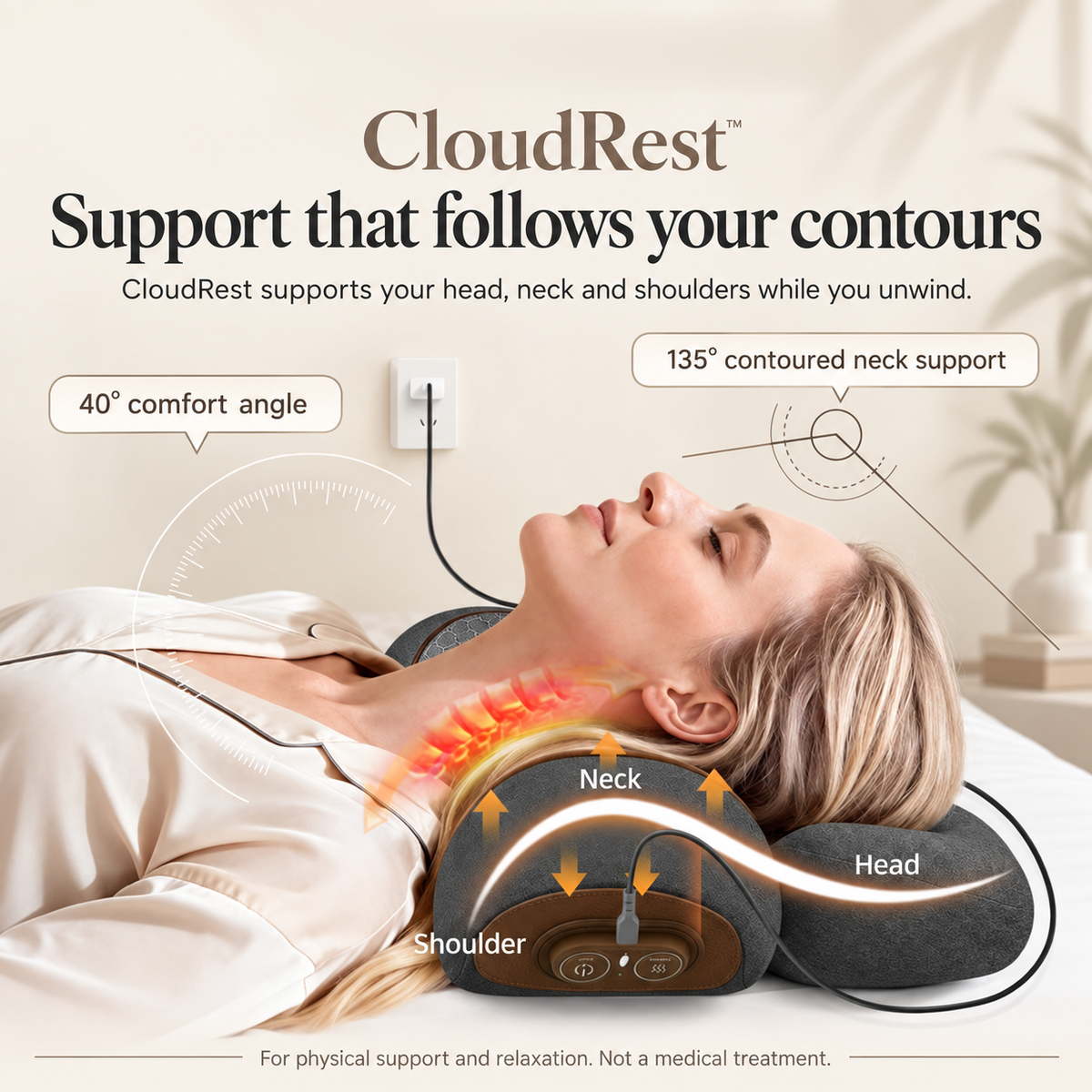
This pillow is called CloudRest, and it was the first thing that met all three conditions. You lie back into it, it plugs into a standard outlet, and one session brings together three things: warmth, gentle vibration and air-assisted movement.

Air traction
A built-in air chamber inflates slowly, lifts and stretches your neck, then releases. It feels like a long, unhurried stretch rather than anything pulling.
Vibration, not kneading
Vibration units spread a light, even buzz across the neck and upper back. No rotating nodes, no single point being drilled into, which is exactly what the cupboard massagers got wrong.
Constant-temperature warmth
Warmth held steady for the whole session rather than climbing. It is the part you feel first, and judging by the reviews, the part that keeps most people coming back.
A heating pad gives you warmth. What I liked here was having warmth, support and gentle movement in the same place, without holding anything against my neck. I could settle into it and let the session run.
Starting it takes one press and hold. The session runs on its own and a built-in timer ends it after thirty minutes, so there is nothing to come back for and nothing to remember to switch off.

What the first month actually looked like
I use it several times a week, not every evening, usually after the days that were heaviest on screens. These are my impressions, not measurements.
The warmth was the first thing I noticed, followed by the slow lift beneath my neck. By the end, my reaction was simple: that was a pleasant half hour. I wanted to do it again.
What had changed was the evening rather than the neck. Thirty minutes with my phone out of reach became the part I looked forward to. Falling asleep afterwards came easier.
The stiffness I usually carry into the evening after a screen-heavy day showed up less often, and the ache that comes with it went too. My head felt clearer in the evenings. That is how it felt to me.
The real test, for me, was whether it would join the other gadgets in the cupboard. A month later I was still reaching for it. The things that work at my age are rarely dramatic; they are the ones you keep doing.
Your month may look different. This is one person's experience, not a study.
The part pages like this usually leave out
Plainly: this is not a medical device. It does not treat a herniated disc, a pinched nerve, arthritis or anything else with a name. If you have sharp pain, numbness, pins and needles, pain that travels down an arm, or anything that wakes you at night, see a doctor rather than buy a pillow.
It is also not for sleeping on overnight. It is for the half hour before sleep, while you slow down.
What it is: a way to give tired muscles warmth and gentle movement at home, with nothing to book and nowhere to drive.
Why women my age take to it
By evening I have usually remembered what everyone else needed. My own comfort is easier to put off. I tell myself I will stretch later, book a massage next week, make time when things quiet down.
What I appreciated about this was how little it asked of me. I didn't have to feel motivated. I just had to make a little room for myself, lie down and let the session run.
You don't have to earn a little comfort by finishing everything first.
From verified customer reviews
“I feel the difference in my neck. It has helped lessen my pain and stiffness. It is very soothing, warms your neck. It's fabulous.”
Deborah W · verified purchase
“I have a lot of neck pain since a whiplash accident in 1988. I use this every couple of days and it keeps the pain away.”
Sheila W · verified purchase
“Every time I use it, my neck feels better and I also fall asleep when using it.”
Ronald C · verified purchase
Why it made sense for me at $109.99
A good massage is still a good massage. But most evenings my actual choice was not between a massage appointment and this pillow. It was between doing something comfortable for my neck at home and putting it off again. That is where CloudRest earned its place.
If you want to try it
If you recognize your own evenings in this story, that is who I had in mind when I decided to offer CloudRest. Someone who already tries to take care of herself, but could use one thing that makes it a little easier.
What matters is how it feels for you: whether those thirty minutes bring you comfort, fit into your evening, and become something you look forward to.
It is $109.99, with free shipping within the United States and thirty days to decide.

The questions I would ask before buying one
Is this a kneading massage, like the ones with rotating nodes?
No. CloudRest combines gentle vibration, warmth and air-assisted movement. It does not use rotating kneading nodes.
Does it need to stay plugged in?
Yes. It runs from an outlet and has no battery, so it is always ready and never waiting on a charge.
What is in the box?
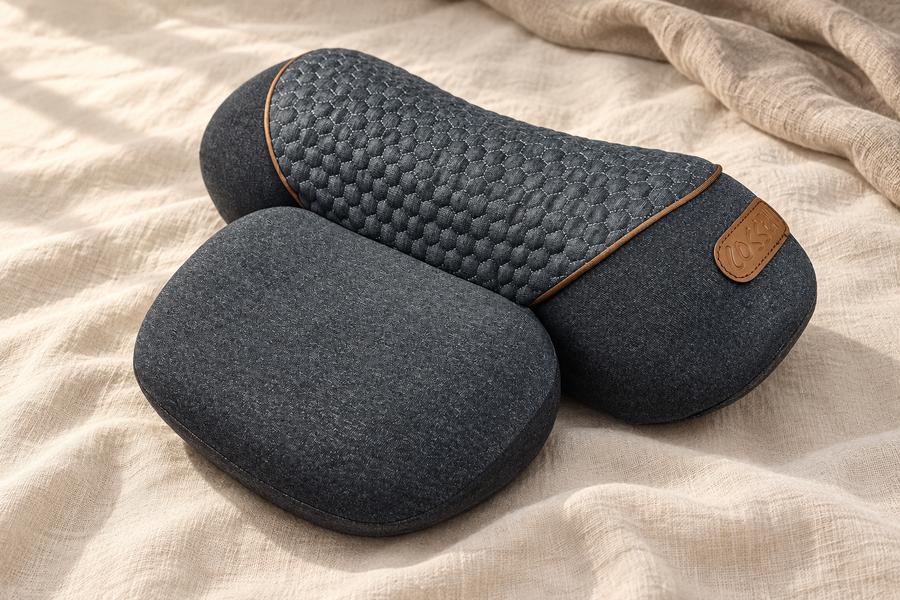
The CloudRest pillow, the separate head cradle, the USB-C cable and the mains adapter, a thin cover cloth and a one-page guide.